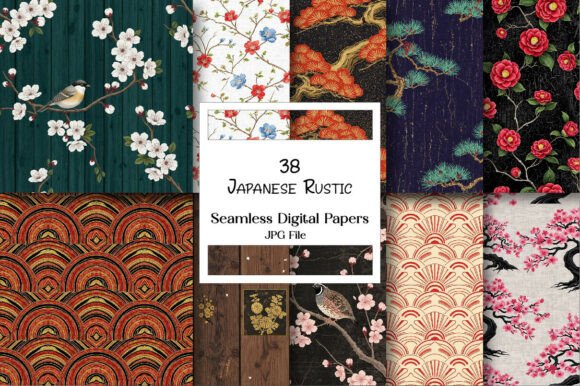
Seamless Japanese Rustic Digital Paper: A Versatile Foundation for Creative Projects
For creators, small business owners, and hobbyists, the efficiency of a workflow often hinges on the quality and versatility of its foundational assets. Seamless Japanese Rustic Digital Paper represents such a cornerstone. It is a high-resolution digital graphic pattern, characterized by rustic textures and motifs inspired by Japanese aesthetics, designed to repeat infinitely without visible seams. This technical characteristic is crucial; it means the paper can be tiled or extended across any size of project surface, from a small sticker to a large wall art print, without breaking the visual flow. Its role fits into the very beginning of a creative or commercial process: the asset acquisition and preparation phase.
Understanding Its Role in the Pre-Production Workflow
Before a physical product is crafted or a digital graphic published, the selection of appropriate materials sets the tone and defines the practical boundaries of the project. Integrating Seamless Japanese Rustic Digital Paper at this stage requires consideration of your end medium. The provided JPG format at 300 DPI is a professional standard, balancing high quality with broad software compatibility. This file can be opened in virtually any image editor, from Adobe Photoshop to Canva or Affinity Designer, ensuring it integrates smoothly into your existing toolset. A practical first step after download is to organize it within your digital asset library. Tagging it with keywords like "rustic," "Japanese," "seamless," and its intended use cases ("sublimation," "printable fabric") will save significant time during future project initiation.
One of the most critical workflow advantages is the resizable dimension. The instruction that dimensions can be resized to suit your needs is not merely a feature; it's a workflow liberator. It allows the same asset to be prepared for multiple outputs within a single product line. For example, a small business owner designing a coordinated set of party decorations can use the same seamless paper file to create napkins, plates, and backdrop graphics, simply by cropping and resizing for each specific print template. This ensures brand and aesthetic consistency across materials, a key factor in professional quality control.
Integration Across Physical and Digital Production Processes
The listed applications—from tote bags and notebook covers to social media backgrounds and website graphics—demonstrate a bifurcated workflow path: physical product creation and digital asset design. In physical production, such as for sublimation printing on tumblers or crafting junk journals, the digital paper acts as the raw material. The process involves preparing the graphic in a design software to match the specific template or dimensions of the blank product (like a mug wrap or a pillow cover), then sending it to print or sublimation equipment. The seamless nature of the pattern eliminates the need to painstakingly match edges on a curved tumbler or a large fabric piece, directly enhancing efficiency and final product quality.
For digital outputs, like trendy social media backgrounds or website graphics, the integration is more immediate. The high-resolution file ensures it remains crisp even when used as a full-screen backdrop. Here, the workflow often involves layering other elements—text, logos, UI components—over the paper. Its rustic, textured nature provides a visually engaging but non-distracting base, supporting readability and hierarchy in the final composition. A blogger or freelancer might use it to create a unified visual theme across their blog headers, presentation slides, and YouTube channel art, establishing a professional and cohesive personal brand.
Practical Implementation for Common Use Cases
Let's examine specific workflow integrations. For scrapbooking and decoupage, the digital paper is printed on suitable physical paper stock. The preparation step involves considering paper weight and finish to match the craft. Once printed, it becomes a traditional material, cut and assembled by hand. For KDP (Kindle Direct Publishing) projects like book covers or interior illustrations, the file is imported into cover design software, where it can be combined with title text and other graphics. The 300 DPI resolution meets KDP's quality requirements for print books.
In a small business product line, such as creating personalized pillows alongside matching playing cards and gift bags, the seamless paper enables a coordinated design rollout. The entrepreneur can design all products from a single asset, adjusting colors or adding personalized text as needed for each item. This unified approach not only streamlines the design process but also creates a stronger, more marketable collection for customers. The workflow here is cyclical: design all items, prepare print files, produce samples, then move to bulk production or on-demand printing.
Factors of Long-Term Usability and Project Scalability
A valuable digital asset should not be a one-time purchase. The Seamless Japanese Rustic Digital Paper is designed for long-term reuse. Its aesthetic, while distinctly Japanese rustic, carries a timeless, organic quality that avoids being overly trend-specific, making it suitable for projects across years. For the productivity-minded user, building a library of such versatile foundations reduces the constant need to source new graphics for every project, saving both time and budgetary resources.
Scalability is another key factor. Whether you are a hobbyist making a single junk journal or a marketer needing backgrounds for an entire campaign's social media suite, the asset scales with your needs. The high-resolution file prevents degradation when scaled up for large format printing, such as for posters or wall art. Conversely, it remains detailed when scaled down for delicate items like soap product labels or bookmarks. This scalability directly impacts project planning; you can confidently plan a large-scale project knowing your foundational graphic will not be a limiting factor.
Tips for Smooth Workflow Integration
To integrate this asset most effectively into your routine, consider these practical observations. First, upon receiving the instant digital download, immediately back up the original file to a cloud storage or archive system alongside your other crucial project assets. Second, create a set of pre-sized templates for your most common outputs. For instance, if you regularly make tumbler wraps, pre-create a canvas in your design software at the standard wrap size, and place the seamless paper as a base layer. Save this as a template file. This turns a versatile asset into a ready-to-use workhorse for repetitive tasks.
Third, experiment with the paper's application beyond the listed ideas. Its texture and seamless nature might make it an excellent background for digital watercolor overlays in graphic design, or a subtle texture layer in 3D rendering projects. Finally, remember that as a digital download without a watermark, the file is ready for immediate commercial or personal use within your projects, removing a final preparatory step of watermark removal that can hinder rapid deployment.
Ultimately, the Seamless Japanese Rustic Digital Paper is more than a simple graphic. It is a process-enabling tool. Its technical specifications—seamlessness, high resolution, adaptable dimensions—are chosen to remove obstacles from the creative and production pipeline. By understanding its role as a foundational element, professionals and creators can strategically deploy it to ensure consistency, maintain quality, and accelerate the transition from concept to finished product, whether that product is a handcrafted gift, a branded business item, or a digital marketing campaign.